I wish I could remember what I already know

I've been saving stuff for 20 years. I'll read a website and think “I need to remember that” or I'll read a book and take notes of the best passages or I'll get a PDF and swear that I will read it one day (the lie I told myself for years!).
And for 20 years all of it - several thousand items - has been sitting unused. Spread across note taking apps, cloud drives, blogs, substacks and bookmarking apps.
A bunch of different filing cabinets dutifully filled, brimming to the top and completely useless when I actually need them.
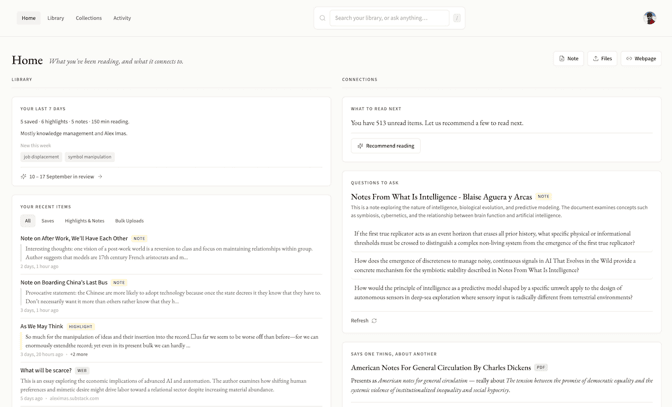
So I built Everett.
Chatbots aren't enough
I hoped that asking a chatbot would finally make all of my knowledge reusable.
It didn't.
A chatbot is great at giving me the average answer, maybe superficially tuned a little bit to me.
But it's not my answer. It doesn't have the 20 years of items I've collected to cite. Even if it did, it certainly hasn't analyzed them to figure out how they all interrelate and how that changes the answer. And there are a lot of smart people who I'd like to weigh in louder than the average voice; their substacks and blogs don't drive the voice and content of the chatbot's answer.
What I wanted instead
I wanted something that made me better at thinking, not a substitute for it.
The idea isn't complicated. Most of what I read connects to something else I've read. If a tool could work out how - not just that two things are related, but that this one backs up that one, or sharpens it, or is the same argument from a different field - then my reading would stop being a pile and start being something I could use.
Also: I'm not smart enough to know how everything connects or what to do with it. I want the tool to show me and prod me with the link or the next set of questions to ask.
The goal is that eventually I'll have an original idea and see the connections between things in a new way.
So that's what Everett does. It reads everything you save, works out how it all fits together, and puts it in front of you when it's relevant. It'll tell you when you're overstating your case. It'll ask you the question you haven't thought of yet. It'll show you two things you read months apart that turn out to be the same idea.
What it won't do is tell you what to think. That's the whole design. Everett proposes; you conclude. When Everett is reasoning on its own rather than citing something you saved, it says so, right there in the answer. Your words stay yours.
Why “Everett”?
I've long been inspired by Vannevar Bush who created the idea of a “memex” in his 1945 essay As We May Think. It's a reminder of how far we have to go.
Turns out Bush was born in Everett, MA and this software comes to you from Seattle which neighbors Everett, WA. Connections!
Where it's going
Everett works well today. And there's still so much to do.
Today it reads what you save, connects it, answers from it, and shows you what it found. What's coming: I want it to tell you when something you just saved contradicts a position you hold — not just quietly file it, but come and tell you. And I want it to track how a position of yours hardens or softens over time, so you can look back and see how you came to think what you think. Plus, I want to build out more ways for you to capture information: more file types, a web clipper to get around password-protected websites. Helping you think more honestly and originally is a job for life.
If you read this far, thanks, and I hope you'll try Everett.
And if you think I've got it wrong, tell me.
— Lindsay Watt
No card needed.